
Lint is the reason dryers start fires, and failure to clean is consistently identified in US fire-incident data as the leading contributing factor in home clothes-dryer fires. It is also, unusually for a fire risk, almost entirely preventable in under an hour.
The reason it gets missed is that the lint trap creates a false sense of security. The screen catches the coarse material. The fine fibre rides the airflow into the duct behind the machine and settles wherever the air slows down: at the first bend, at joints, and at the exterior cap.
The seven signs, roughly in the order they appear
- Clothes are still damp after a full cycle. The first and most common. Restricted exhaust means moisture stays in the drum instead of leaving the house. If you routinely run a second cycle, this is why.
- The dryer or the laundry room is hot to stand next to. Heat that should be leaving through the vent is staying in the cabinet and the room.
- Little or no air at the exterior vent. The easiest test you can do yourself. Run the dryer, go outside, hold your hand near the vent. You should feel a strong warm flow. A weak trickle means the line is restricted.
- A burning or scorched smell during a cycle. Stop using the machine and get it looked at. This is not an early sign.
- Lint appearing around the door seal or behind the machine. Lint that cannot go forward comes back.
- The exterior cap is rusted, stuck open, or missing its flap. Near the water this component fails first, and a cap stuck open lets in rain and birds. Wet lint packs far harder than dry lint.
- It has never been professionally cleaned. Not a symptom, but the strongest predictor. If you have lived in the house five years and never had it done, the line is loaded.
Why a new dryer does not help
A common assumption, and the opposite of true. Older machines ran on a timer, forty minutes was forty minutes whether the clothes were dry or not. Newer machines use moisture sensors, which means a restricted vent makes them run longer to reach the same result. Better technology, worse outcome, higher bill.
A moisture sensor does not know the vent is blocked. It only knows the clothes are still wet, so it keeps going.
What about the kits you can buy?
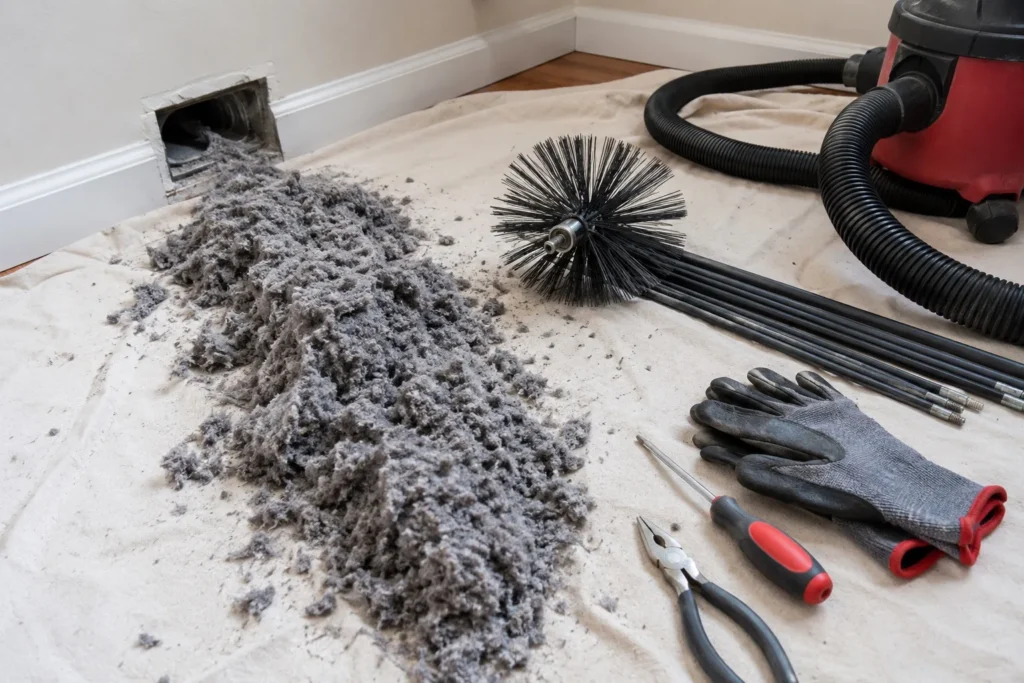
They are better than nothing and we will say so plainly. A brush kit from a hardware store will clear the first few feet behind the machine, and if that is where your buildup is, you have solved it.
The problem is that the buildup that matters is usually not there. It is at the bends, in the run through the wall or ceiling, and at the exterior cap, which on a two-storey house may be at roof level. That is where store-bought kits stop reaching, and it is why a line that has been cleaned by hand can still fail an airflow test.
How often
Once a year for most households. More often with a large family, a long or complicated duct run, or if you dry bedding and towels heavily. If you have a stacked unit in a condo closet with a tight bend behind it, err on the shorter side. Here is how we clear the full line, from the appliance to the exterior cap. Those runs load faster than a straight run through an exterior wall.
Recognise two or more of these?
A dryer vent cleaning is usually under an hour. It is the cheapest fire prevention available to a homeowner.
Book a visit this week
Free quote, honest price, and photos of the work when we are done.
Or call us