Home / Chimney sweep
Chimney sweep in South Florida
A chimney sweep in South Florida is a different job than it is up north, and the difference works against you rather than for you. A fireplace you use three nights a year still needs the same annual inspection as one burning all winter, because of what moves in during the other three hundred and sixty-two days.
The local case
Eleven idle months is the actual problem
Most people assume a Florida chimney needs less attention than one up north. Cost and booking questions are answered in the FAQ. Less use, less soot, less to worry about. The first half is true and the conclusion does not follow.
A flue in Vermont is hot and dry most of the winter. Fire after fire drives moisture out of the masonry, and the chimney gets used often enough that problems announce themselves early.
A flue in Broward County sits open, cool and humid for most of the year. Nobody looks at it. Nothing disturbs it. A sheltered, undisturbed vertical shaft is an extremely attractive place to live if you are a bird, and debris collects on the smoke shelf with nothing to burn it off.
Then a cold front comes through in January, somebody lights the first fire since last year, and finds out what has been up there. That call is the one we get every winter, and an inspection beforehand prevents nearly all of it.
Storm season
What storm season does to a chimney
This is the part most South Florida homeowners never think about, and it causes more damage here than creosote does.
The result usually shows up indoors as a stain on the ceiling near the chimney breast, or a musty smell that is worse after rain. People blame the roof. Often it is the chimney.
If you have been through a named storm since your last inspection, that is a reason to book one regardless of whether you plan to light a fire.
Where storm damage shows up
- Crown cracks, the concrete slab on top takes sun, heat and heavy rain in cycles all year
- Constant saturation and drying widens those cracks, not freeze-thaw
- Wind lifts or loosens the cap, leaving the flue open
- Flashing works loose where the chimney meets the roof
- Water tracks down inside the wall and stains the ceiling
Creosote
What creosote is and why it still matters
Creosote is the tar-like residue wood smoke leaves on the flue wall. It starts as a light, flaky deposit. With repeated low, smouldering fires it hardens into a glazed layer that is genuinely difficult to remove and genuinely flammable.
Light use means less of it. But two habits common in this climate produce more per fire than you would expect.
Damp wood. Wood stored outside in South Florida humidity is rarely as seasoned as the person burning it believes. Damp wood burns cooler and smokier, and smoke is what deposits creosote.
Damping down. When the fire is for atmosphere rather than heat, people close the damper to make it last. A slow, smouldering fire is exactly the condition that produces the hardest glazed creosote.
Call before you light it if
- Smoke pushes back into the room instead of drawing up
- There is a sharp, smoky smell with no fire lit, worse on humid days
- You hear scratching, rustling or chirping above the damper
- Dark flakes or gritty debris appear on the hearth
- The damper sticks, will not seal, or will not open fully
- There is no cap on the flue, or the cap is visibly damaged
- It has not been inspected since last season
Know what you are buying
What an inspection actually covers
Almost nobody in this market explains this, so here is the plain version. Inspections come in levels. Knowing which one you need stops you overpaying and stops you under-buying.
01
Basic visual
Covers the readily accessible parts: firebox, damper, the visible flue, and the cap and crown from the roof. The right choice for a chimney in normal service that you use the same way every year.
02
Adds internal surfaces
Includes the accessible internal surfaces and a camera run up the flue. You want this after buying the property, changing how you use the fireplace, converting fuel type, or a storm or suspected chimney fire.
03
Detailed
Involves opening up concealed areas. Only appropriate when a serious structural problem is suspected.
If someone quotes you a chimney inspection without telling you which of these you are getting, ask.
Buying or selling
Before you close on the house
South Florida properties change hands with fireplaces nobody has used in years. A buyer home inspector will usually note a fireplace and recommend a specialist look at the chimney, because a general inspection does not cover the flue.
If you are selling, an inspection with photos gives you something to hand over. If you are buying, it tells you whether you have inherited a working fireplace or a repair bill. Either way, book it before closing rather than after.
What we check on every visit
- Flue liner, cracking, spalling, gaps, and whether it can contain a fire safely
- Smoke chamber and smoke shelf, including nests, leaves and parging condition
- Firebox, cracked or missing refractory and deteriorated mortar joints
- Damper, whether it opens fully, closes, and seals
- Cap, crown and flashing, the parts that corrode and crack fastest here
- Creosote level measured against how you actually use the fireplace
How it goes
What the visit looks like
Assess
We look at the firebox, damper and up the flue before deciding how the sweep should be approached.
Contain
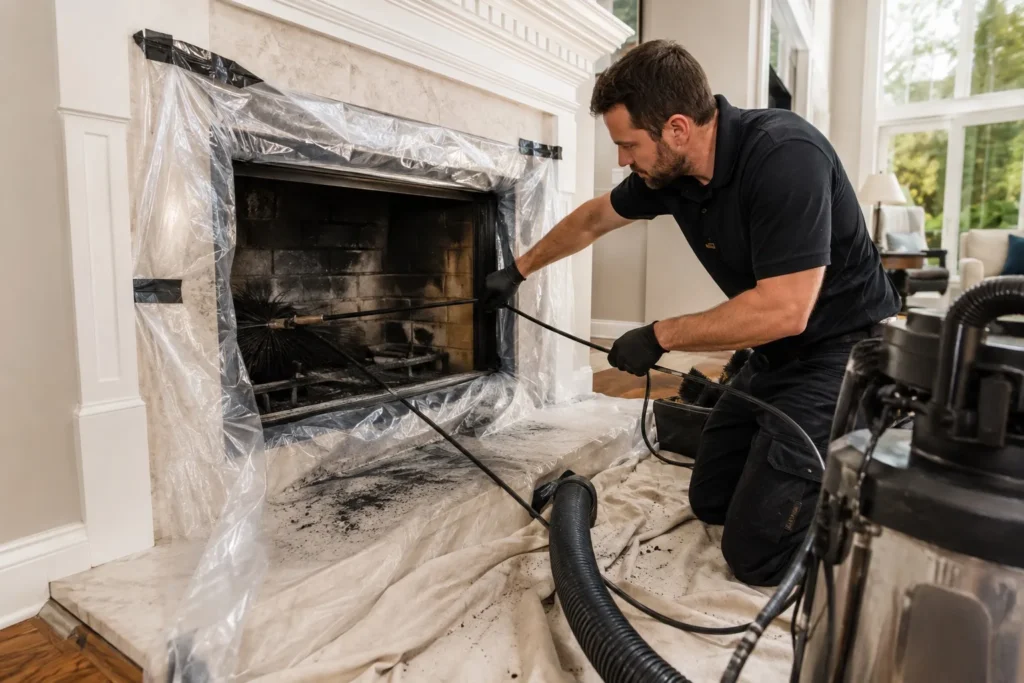
The hearth and surrounding room are sealed and protected. Soot belongs in the vacuum, not on your floor.
Sweep and report
Mechanical brushing of the full flue with vacuum extraction, then a plain-language walkthrough with photos and a straight answer on whether it is safe to use.
Sometimes that answer is that it is fine and does not need sweeping this year. We would rather tell you that than manufacture a job. What you are buying is the answer, not the sweep.
Gas fireplaces
Gas fireplaces are not exempt
Less creosote, same everything else. The vent still needs checking for blockages, the flue for corrosion, and the cap for the nesting and debris that do not care what fuel you burn.
Gas appliances also produce moisture and mildly acidic condensate, which is hard on an unlined or deteriorating flue over time. Tell us which type you have when you book so we bring the right equipment.
Yes, and it is the most common misunderstanding we run into. Light use means less creosote but the same exposure to nesting, moisture and debris, and more undisturbed time for all three to accumulate.
An inspection once a year before you plan to use it. The National Fire Protection Association standard for chimneys calls for annual inspection regardless of how often the appliance is used. Whether it needs a full sweep depends on what the inspection finds.
It should not be. The hearth is sealed and everything runs through vacuum extraction. If we leave soot on your floor, we have not done the job properly.
We clean and inspect. If we find damage needing masonry or liner work, we document it clearly with photos so you can hand it to the right trade. We will not invent a problem or quietly ignore a real one.
Usually under an hour for a standard sweep and inspection. Heavy glazed creosote or a blocked flue takes longer.
Broward and Palm Beach County. We are based in Hallandale Beach and do not currently serve Miami-Dade.
Request a free quote
Tell us what you are noticing and we will follow up with a price and a time.
Also worth checking
Related services
Full-system vacuuming and sanitizing, from the air handler out to every register.
The whole line cleared, from the appliance to the exterior cap. The clearest safety case we make.
Book a visit this week
Free quote, honest price, and photos of the work when we are done.
Or call us