
Broward and Palm Beach County are full of buildings where the dryer is in a closet, the unit is stacked, and the vent does not exit through a wall three feet away. If you live in one, the standard advice you find online is close to useless.
Three things that make condos different
The run is longer and more complicated
In a house, the duct usually goes straight through the nearest exterior wall. In a tower it may travel through a ceiling, turn twice, and join a riser that carries several units to the roof. More length and more bends mean more places for lint to settle, and the load builds faster than an equivalent house.
The installation is tighter
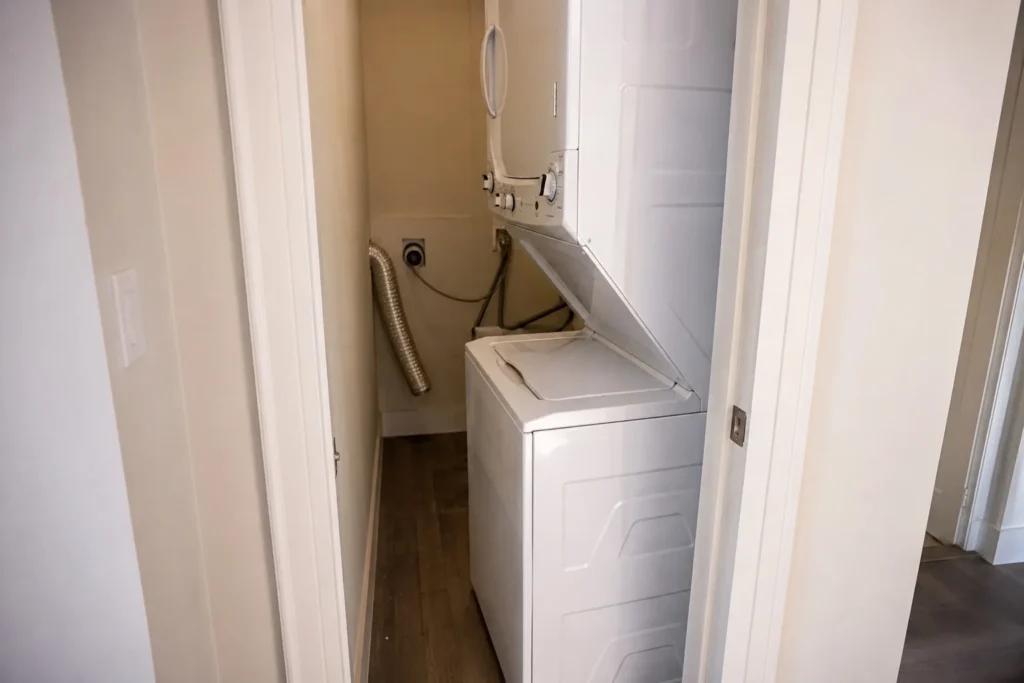
Stacked washer-dryers in a closet leave very little room behind the machine, and the flexible duct is often crushed into a bend just to make the door close. A crushed duct restricts airflow permanently, and no amount of cleaning fixes it, it needs replacing. We will tell you if that is what we find rather than cleaning around it.
You may share the exhaust
Some buildings run individual lines to the roof. Others tie multiple units into a shared riser. If yours is shared, your airflow depends partly on your neighbours lines and on the building maintaining the riser. Cleaning your section still helps, but it is worth knowing which arrangement you have, and worth raising with the association if the riser has never been serviced.
The access side, which is most of the friction
The actual cleaning is usually under an hour. Getting into the building is what turns a simple job into a rescheduled one, and it is entirely avoidable with a bit of notice.
- Certificate of insurance. Most management companies require a vendor COI on file before anyone works in the building. Send us the requirements when you book and we file it ahead of time.
- Vendor registration. Some associations maintain an approved-vendor list and will not admit anyone not on it.
- Freight elevator windows. Common in the beachfront towers, often restricted to weekday business hours and sometimes requiring a reservation days ahead.
- Notice periods. A few buildings want 24 or 48 hours notice before a contractor arrives.
The cleaning takes an hour. The building paperwork is what decides whether that hour happens this week or next month.
Who pays, you or the association?
It depends on your building documents, and we cannot answer it for you. The general pattern is that the section inside your unit is yours and the shared riser is the association responsibility, but that varies and your declaration is the authority. If you are unsure, ask your property manager before booking. Some buildings run whole-building vent cleaning on a schedule and you may be paying for something already covered.
If you are a property manager
Doing a stack or a floor at once is significantly more efficient than unit by unit, and it means one set of access arrangements instead of twenty. We can coordinate multiple units under one schedule with a single point of contact. Tell us the building and how many units and we will scope it properly. More on dryer vent cleaning, and on working in Hallandale Beach buildings.
In a building with access rules?
Tell us the building or management company when you book. We handle the paperwork before the appointment, not on the morning of.
Book a visit this week
Free quote, honest price, and photos of the work when we are done.
Or call us